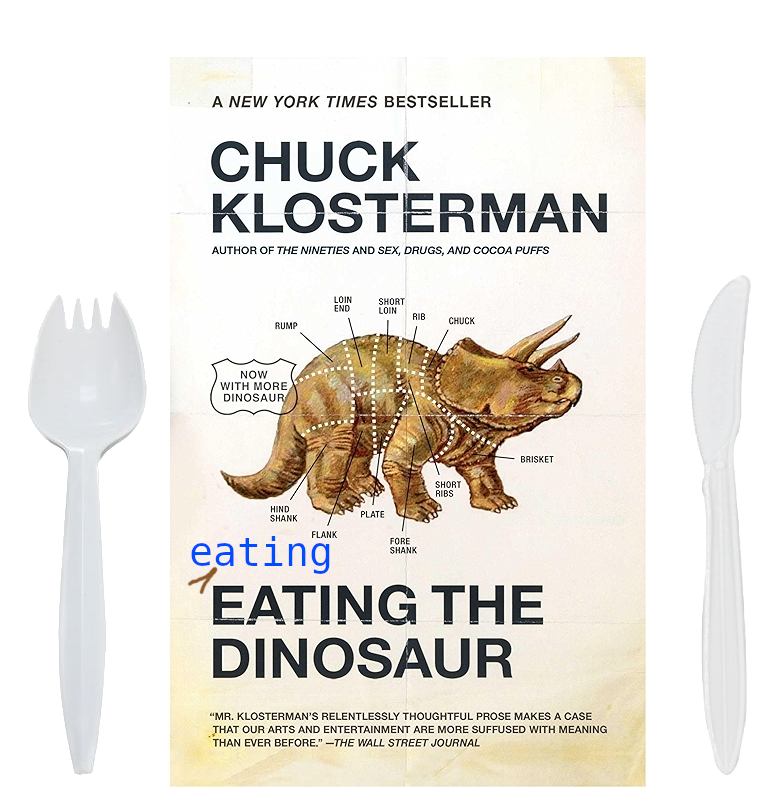
***There was no design found for this blog in Bryan's files, so this one was created.***
Home Blogs Eating Eating The Dinosaur
Eating “Eating the Dinosaur” (Part 1)
I thought I’d blog my way through Eating the Dinosaur, Chuck Klosterman’s 2009 book of pop culture essays, because it’s a good read and as I go through it I find myself wanting to respond and generate my own thoughts about the topics he covers. This isn’t a review; I may well end up stripping the topics out of these essays and discussing them without saying anything about what Klosterman says about them. Okay? Okay!
I relate to Klosterman because he’s a classic overthinker as well as a contrarian. Fortunately, he’s engaging enough that his beanplating, rambling and convoluted as it frequently is, goes down pretty smoothly thanks to a breezy sense of humor, and he almost never comes off as a rantaholic crackpot, as contrarians are wont to do. (The one unfortunate exception that comes to mind is his grouchy dissection of tUnE-yArDs, in which Klosterman comes off as a crabby what’s-all-this-then oldster as well as a bit of a mansplaining dick.) He reminds me of a cool, geeky college professor, the kind who likes to spend the whole class speculating about stuff and going off on tangents, and never gets past the first third of the syllabus before the end of the semester.
What really endears Klosterman to me, though, is that he’s a master at something I love dearly — making sweeping, counter-intuitive assertions that appear ridiculous on their face. These kinds of statements — “Is there a commonality between the recording of Nirvana’s In Utero and the siege of the Branch Davidian compound in Waco?” or “Football: the most liberal sport?” — seem to be asking for an actual answer, and that answer is nearly always going to be an irritated “No, of course not, and please stop saying things that are bullshit.” 1
Challenging these assertions, though, is missing the point. They’re questions that aren’t meant to be answered so much as pondered. They’re not requests to be coldly evaluated and given a thumbs-up or down, but invitations to journey down a road of speculation and analysis. The journey may or may not lead anywhere definitive, but it’s not about the destination. At the heart of each these meandering, sometimes maddeningly circuitous ruminations lies a koan, not a conclusion. Read with a generous spirit and open mind, they can yield fascinating insights. Or at least a few minutes of diversion while you’re on the toilet.
The first essay, “Something Instead of Nothing,” may be the most divisive of the lot, seeing as how it’s basically Klosterman talking about Klosterman, or more specifically Klosterman, Famous Author Who Gets Interviewed and Feels Angsty About Being Interviewed. But starting the book this way establishes what I suspect is the overarching theme of the collection — or perhaps it’s merely what Klosterman always writes about: our sense of who we are, our sense of how we think others see us, how others actually see us, and the many ways in which the interplay between the three can massively fuck us up.
Interviews, as a journalistic instrument, are interesting because they’re completely unnatural and artificial situations created for the sole purpose of prying open and examining a human being’s inner self. There is no naturally occurring social interaction — except maybe for dating — in which one person peppers another person with questions designed to open up their heads and allow the questioner to peer inside and gather whatever it is they’re looking for.
I’ve been an interview subject twice in my life. Once by a Toronto newspaper for being a vociferous fanboy of a massively popular but critically lambasted film — I will decline to elaborate on this — and once by the New York Times for a website I created (back in the early days of the Internet era, when any halfway interesting website was deemed worthy of notice). Both times, I found the experience intensely disturbing and strange.
When a complete stranger seeks you out and asks you detailed questions about intimate details concerning your history as a person and your motivations, assiduously probing your inner life, it provokes reflexive questions in the back of your mind. The interviewer obviously doesn’t know me personally, barely knows who I am, yet for some reason either cares or is pretending to care about me, my life, and my opinions.
We are not friends. We are not two friendly strangers getting acquainted in a social setting. And the questioning is almost entirely one-way — I do not know what this interviewer’s true motivations are, or what they intend to do with the words and information I am giving them. I don’t know what their feelings are about me — they might even dislike me. How often in life do you find yourself asked to reveal your inner self to someone who not only isn’t genuinely or personally interested in you, but who may in fact hold you in total contempt? 2
Given the unnatural, perhaps even hostile, strangeness of this situation, why do people agree to be interviewed? Aside from the obvious motive of self-promotion, perhaps being interviewed helps the interviewee understand their own self. Errol Morris, a Klosterman interviewee, says something interesting about “privileged access” to one’s own mind:
“My mind resides somewhere inside of myself. That being the case, one would assume I have privileged access to it. In theory, I should be able to ask myself questions and get different answers than I would from other people, such as you. But I’m not sure we truly have privileged access to our own minds. I don’t think we have any idea who we are. I think we’re engaged in a constant battle to figure out who we are.”
Do we really have a clear sense of ourselves? I’m not sure I do. I think thoughts about the world, experience emotions, feel impulses and desires, look back on my past and form plans for my future. I can “see” myself in past events and form impressions and opinions about that past self. That time I found a phone book on the front stoop of an apartment building, and set fire to it? I see myself hunched over that phone book, grinning maniacally while I hold a Bic lighter to the pages, and think, “wow, what a fucking dumbass.”
But for the most part, I suppose most of my sense of self comes from my interactions with other people and trying to see myself through their eyes, sort of an inversion of a blind person feeling someone’s face to get a sense of their form. I am blind to myself and can only know who I am by feeling out other people’s impressions of me.
Something stupid I used to do in college, in letters I wrote to my friend Kevin, was the “self-interview,” where you ask yourself questions about yourself, and go on to answer them. “How is your Weltschmerz expressed through your poetry?” I’d ask myself, and then I’d answer at length. Even at the time I considered this extremely stupid, yet I still did it. Why? What’s the difference between saying something about myself via this artificial device, and just, y’know, saying something about myself?
I think it’s because most people who aren’t narcissists feel some measure of embarrassment or even shame in talking about themselves, even though we very much want to do so. It’s probably tied to one’s self-worth. If you don’t place very much value on yourself or your significance in the world, talking to other people about yourself feels like an unseemly imposition. And yet, even people with shitty self-worth want to be known and understood. The interview, even if it’s a fake one you made up yourself, functions to mediate your desire to make yourself known to the world. 3
Since it’s stupid to interview yourself, people in a position to command the curiosity of large numbers of other people must rely on an outside party to interview them and to share that interview with that audience. But that of course puts you at the mercy of that interviewer, who may well misquote you or misrepresent you. Hence the ambivalence and mistrust and angst that people tend to feel about being interviewed.
If you’re not famous (or infamous), of course, it’s unlikely that you’re going to be asked for an interview, unless you’ve committed or witnessed a crime, or it’s for some minor but interesting thing you’ve done, or for being exceptionally ridiculous in some newsworthy way. Most people are very rarely, if ever, given access to this outlet for self-expression. Hence the massive popularity of Facebook and Twitter.
🍴
Eating “Eating the Dinosaur” (Part 2)
One thing that makes these essays an engaging read is that, with some of them, it’s almost impossible to tell going in what the actual theme of the essay is going to be. Klosterman likes to start off with a little riff that relates to, but isn’t actually, his intended topic. “Oh the Guilt,” for instance, begins with a discussion of guitar-smashing. “People wreck guitars to illustrate how important guitars are supposed to be,” he writes.
But this essay isn’t actually about rock stars smashing guitars. Except that it kind of is. Specifically, Klosterman wants to talk about how the band Nirvana used to smash their equipment — what smashing their equipment meant when they were a poor, struggling, unknown band, and what it meant when they were one of the biggest bands on the planet.
But this is all just an extended segue into the subject of Kurt Cobain and his sense of identity in context of his fame, success, and mainstream popularity, studied against the backdrop of the recording of Nirvana’s In Utero album, which Klosterman describes as “the first album actively promoted as a product I needed to buy because I was not going to like it.”
Oh, and somehow this is all tied to David Koresh and the 1993 siege of the Branch Davidian compound in Waco by the U.S. government.
Klosterman’s overarching thesis about Cobain is that he was miserable because he was ashamed of and could not deal with his commercial success. He believes In Utero was a product of that shame — he calls it “Guilt Rock” — an album that was deliberately conceived as a repudiation of the kind of success Nirvana didn’t want, and the kind of fans Nirvana didn’t need, and as a way to retain — or regain — Nirvana’s credibility as anti-mainstream champions of the punk ethos, even as they had become the most mainstream band in the world at that time.
When Nirvana released their Incesticide compilation of B-sides and miscellaneous oddities in 1992, early pressings included a liner note written by Cobain (Geffen removed this note from the CD sometime in the mid-90s), a lengthy, rambling collection of rants and raves, including a defiant defense of his embattled wife, Courtney Love, and an exhortation to any homophobes, bigots, or misogynists listening to his music to please go away.
The bulk of the text is a story of how Cobain got a vinyl record by the Raincoats sent to him from London, and a long list of experiences that receiving this album was as rewarding as: touring with Shonen Knife and Sonic Youth, playing with the Vaselines, Daniel Johnston sending him drawings, and so on. (Cobain probably would have had a pretty entertaining weblog if he’d stuck around for the Internet era.) This obscure recording made Cobain
…happier than playing in front of thousands of people each night, rock-god idolization from fans, music industry plankton kissing my ass, and the millions of dollars I made last year.
Much of Klosterman’s essay is taken up with trying to figure out what fueled Cobain’s monumental self-loathing and discomfort with his success. This note, I think, says as much as anything else about what made Cobain hate himself so much. To me, what this note says is that Kurt Cobain was a huge, ultra-sincere music geek. He never stopped being a wide-eyed fan of the punk bands he idolized in his pre-megafame years, as well as his contemporaries who embodied his own anti-commercial, anti-mainstream values. Yet Nirvana’s success isolated Cobain from his heroes and peers to a greater degree than any other rock musician I can think of.
For an ambitious mainstream rock band like, say, U2, achieving massive global success brings them closer to their heroes. But when your role models are bands like The Stooges and The Velvet Underground, there can’t be anything more confounding and non-validating than finding yourself ushered into the top tiers of pop culture royalty, where your new peers are the likes of Garth Brooks and Britney Spears. When you make the kind of music Nirvana aspired to make, and end up where they did, you have, in every important way, failed as an artist.
Which is not, of course, to say that artistic integrity and commercial success can’t coexist. Prince, as far as I can tell, has never wavered from his singularly strange musical vision, no matter how it’s evolved over the years. He may have changed courses many times during his career, but never, as far as I can tell, in order to appease a record label or his fans.
And the reason for that, I think, is that he’s so supremely dedicated to his vision, and confident in his abilities to realize that vision, that there just isn’t room in his ego to accommodate the desires or opinions of others. He’s supremely media savvy and concerned about being understood by his audience 1, but his concern is solely about being accurately seen, not about being seen a particular way.
Cobain, on the other hand, was unable to process his stardom in a way that would allow him to exist as both a rock star and an artist of integrity, because he lacked the necessary egotism to disregard the opinions and demands — or in some cases, the very existence — of his audience and critics, and simply follow his muse.
Klosterman illustrates his thesis in a pretty clever way. By putting Nirvana’s schtick of trashing their instruments during their concerts side by side with their attempt to record a deliberately abrasive, anti-commercial followup to their commercial smash, he makes the case that Cobain’s fatal flaw was his inability to not engage with his fans.
He could not stop himself from caring about people who would only appreciate his work if he were a mainstream failure, just like they were.
Why did Nirvana continue to destroy their instruments after becoming famous? It wasn’t a punk gesture anymore — Nirvana could afford to smash truckloads of guitars. Post-success, it was a totally meaningless spectacle. Yet they continued to do so, because it was expected of them. And instead of just making whatever the hell album they wanted to make, Nirvana tried to make an album that would elicit a specific response from their audience and their critics.
It’s conceivable, maybe, that Cobain could have pulled back from the abyss had he been able to say “fuck the audience, fuck the critics, I’m just gonna do what I do, and they can love it or leave it.” But he couldn’t do that. In Utero is the final product of that inability. Nirvana set out to create something abrasive, unlistenable, and uncommercial — not as a musical statement, but a cultural one. It wasn’t representing Nirvana the band so much as “Nirvana,” the rock-pop phenomenon. And this album, whose selling point was its uncommercial artistic credibility, ended up selling 4 million copies and being faintly praised as a decent pop product by a mainstream band.
Although I, along with practically everyone else in America, played the shit out of Nevermind throughout 1991 and 1992, I wasn’t much more than a casual fan. Reading this essay moved me to listen to In Utero in full for the first time since probably 1994, when Cobain killed himself and I, along with everyone else, dug out their CD to rummage through it for portents of his impending self-annihilation.
At the time the album came out, I liked the same songs everyone else did — “Heart-Shaped Box,” “Rape Me,” “All Apologies,” and “Pennyroyal Tea.” I think they still hold up pretty well. Listening to the album now, though, I find that the songs that really kick my ass are the abrasive, “ugly” ones. They’re the ones that still sound fresh and exciting.
The one that hits me hardest is the second track, “Scentless Apprentice.” Not so much because of the music or lyrics (inspired by Patrick Suskind’s novel Perfume), as the way the song builds to the explosion of Cobain’s raw, throat-shredding scream — the actual words barely discernible — that comprises the chorus.
I know it’s cheesy, but I can’t help hearing the chorus as Cobain howling desperately, over and over, into an indifferent windstorm of guitar riffs and drumbeats, as if he’s projectile vomiting the demons consuming him from the inside only to have them flung back into his face. A howl of despair, agony, rage, and utter helplessness.
Next: David Koresh and America’s fear of the weird.
🍴
Eating “Eating the Dinosaur” (Part 3)
 As a tribute to Klosterman, I’m going to start this blog entry with a long, rambling preface with dubious connections to the topic at hand.
ALL THE CRAZY
In my junior year of college, I signed up for a university research study for a drug called Milacemide, which was being studied to see if it could be used as an antidepressant. I saw an ad for it in the local alternative weekly, and figured what the hell. I was depressed, although probably not any more so than usual — depression for me is more or less seasonal and perennial, like allergies. But on top of the depression, I’d been concerned about my mental health because of some unrelated “issues” I’d been experiencing that year.
For example, one night I was having dinner in the Union South cafeteria. As I ate my enchilada casserole and watched the CBS Evening News on the dining room TV, I suddenly heard Dan Rather’s voice. Which wouldn’t have been so strange, since he was on TV at the time, except that in addition to his on-air voice, he was also whispering directly into my left ear. What Dan Rather said to me, his voice soft and menacing, while his regular, authoritative TV voice reported the day’s news to the rest of the world, was this:
“Fuck youuuu…fuck youuuuu.”
He said this over and over, for about a minute. Profoundly weirded out, I wolfed down the rest of my dinner and got the hell out of there. Fortunately, this never happened again, but ever since I’ve been unable to hear Dan Rather’s voice without breaking into a cold sweat.
At around the same time, I was also wrestling with the question of whether or not I had the ability to project my thoughts into other people’s minds. The thought popped randomly into my mind one day, and I couldn’t shake it. I began to covertly observe everyone I interacted with, or who sat near me in class, to see if they showed any reaction when I directed my thoughts at them. Many of them did in fact behave a little strangely around me — for reasons I’m sure had nothing to do with the fact that I was covertly observing them — and I became semi-convinced that my thoughts really were being beamed out of my head and into the minds of people in my vicinity.
Of course, I couldn’t be positive, since no one actually said anything to me, and since the idea was completely batshit insane in the first place. So I determined to put the question to the test. Leaving Union South one day, I saw a girl standing on the sidewalk, waiting for a bus. I sat down on the steps outside the entrance, directly behind her, and commenced hurling insults at her with my mind. After about a half minute of silently, vehemently denigrating her appearance, personality, and intelligence, I was stunned when the girl turned around and looked at me, with a strange expression on her face. I couldn’t believe it — had I actually caused this girl to turn around, with my thoughts alone, without having made any audible sound?
Or…perhaps it wasn’t that at all. Perhaps, without realizing it, I had in fact spoken my thoughts out loud. I hadn’t been aware of my lips moving or sound coming out of my mouth, but people had pointed out my entire life that I often unconsciously moved my lips when thinking hard. If it had indeed been the case, how fucking scary crazy must I have looked to this poor young woman — some creepy stranger berating her out of nowhere at a bus stop. And what was crazier — believing I was some kind of telepathic thought-broadcasting antenna, or the possibility that I was speaking my thoughts out loud without realizing it?
In retrospect, given that I wasn’t using PCP or any other mind-altering drugs at the time, I probably should have mentioned this stuff when I signed up for the study.
Even though I’d been depressed most of my life, and as a child exhibited antisocial, occasionally violent behavior, this clinical study was my first real exposure to the mental health profession. If I’d been born a few decades later, in more enlightened times, I probably would have been identified as mentally ill and put into therapy by the time I was five. But it was the early 70s, and I’m pretty sure the idea of taking me to a shrink never even occurred to my parents. 1
I had been interested in psychology from early childhood. In the summer after fourth grade, my parents bought me the Great Books of the Western World collection, in the optimistic hope that their ten-year-old kid would get hooked on the fifth century Greek tragedies of Aeschylus. To what must have been their pleasant surprise, I actually did read a few of the Great Books (making me the only North American child ever to do so). The only one that really caught fire in my head, though, was the Sigmund Freud volume, a “best of” sampler of his major works. I read the shit out of that book — cover to cover and multiple times. That and Heinlein’s Have Space Suit, Will Travel were my go-to reading matter during my elementary years.
During the course of the study, which required me to make twice-weekly trips to the university hospital to replenish my meds and attend counseling sessions with one of the study’s psychologists, I discovered the Diagnostical and Statistical Manual of Mental Disorders, or DSM. Most people who’ve experienced or studied up on mental illnesses are probably familiar with this book. Published by the American Psychiatric Association, it’s a standard reference in the mental health field, a catalog of officially recognized mental disorders, along with criteria for diagnosis.
For someone with an enthusiastic interest in psychology, but without any formal education on the subject, finding this book was like an aspiring chef discovering Larousse Gastronomique. During my clinic visits, I dove into the copy in the waiting room every chance I could get, and eventually started taking the long trek out to the hospital on non-study days, just to hang out in the medical library and work my way systematically through the whole thing. (These trips, incidentally, were in lieu of attending classes, which I was getting C’s and D’s in because I was too busy learning about mental problems to bother with my actual paid-for, contributing-to-my-degree learning.)
What blew my mind about the DSM is how totally comprehensive it was. It was all here — all the crazy. Virtually every possible way that human beings can be fucked up in the head, from depression to schizophrenia to the compulsion to rub your crotch against strangers’ rear ends on the subway, was represented in these pages in precise clinical detail, along with the diagnostic criteria for each disorder. It was like a Field Guide to North American Lunatics combined with a Troubleshooting and Repair Manual for the Mind.
The second most fun thing about the book — the first being the section on sexual fetishes, of course — was figuring out how many personality disorders I could potentially qualify for. Schizoid personality disorder? Maybe. Schizotypal personality disorder? Probably! Antisocial personality disorder? Sure, why not! Which points to one of the most common criticisms of the DSM (and mental health diagnoses in general): there is no human being who doesn’t have at least one disorder listed in this book, to some degree. So does that mean everyone’s crazy?
Well, yes, obviously. But the DSM makes it clear that, while everyone might be fucked up in one way or another, there’s a difference between “normal” fucked up and “abnormal” fucked up. A little shy and introverted? Normal fucked up. Haven’t left your apartment in three years and sleeping on tied-up bundles of newspapers with your eighteen cats? Abnormal fucked up.
For mental health professionals, distinguishing normal from abnormal mental conditions is a complex and often controversial process. For non-professionals, though, it usually gets simplified down to two basic points of view. (I’m generalizing of course, but broadly speaking I think this is true.)
One point of view defines mental disorder as behavior severe enough to significantly affect their ability to function in society. The mentally ill person may have difficulty getting or holding down a job. If they have a job, they may fuck up in some dramatic way, or behave in a way that disrupts the workplace. They cannot live self-sufficiently and depend on family or government assistance. They behave in a way that hurts themselves or other people.
The other point of view is even simpler: to be mentally ill is to be weird enough to disturb society’s sense of propriety.
HOW NOT TO BE BATSHIT INSANE
It is difficult for me to write objectively about Koresh. It’s difficult because I cannot see any framework where he and his followers were not murdered by the U.S. government (or—in the absolute best-case scenario—driven to commit mass suicide).
On the morning of February 28, 1993, an 80-vehicle convoy of ATF agents descended on a ranch about nine miles outside of Waco, Texas. They were there to execute a search warrant on the Mount Carmel Center, which was owned and inhabited by a breakaway sect of Branch Davidians, a Christian religious group that was itself a breakaway sect of Davidian Seventh-day Adventists, who were a breakaway sect of Seventh-day Adventists.
The ATF agents wanted to search the Branch Davidians’ commune for two reasons: they had heard reports that children of the Branch Davidians were being abused, and they suspected the group was stockpiling illegal firearms. Mostly, though, what the ATF wanted was to arrest the commune’s religious leader, a man named David Koresh.
Specifically, the ATF believed Koresh, in addition to buying and selling illegal assault weapons and weapon parts, was physically abusing children in the commune, and that he was also having sexual intercourse with underage girls. More generally, the ATF believed Koresh was batshit insane.
Was David Koresh batshit insane? Probably, or at least to the extent that anyone who believes he’s a descendant of King David and a prophet who has unlocked the mysteries of the Seven Seals of the Book of Revelation and The Lamb of God destined to open the Seals during the imminent Apocalypse, and who believes himself divinely tasked with siring 24 children who will become the ruling elders of the millennium following the Apocalypse, can be.
I realize Koresh was fucking crazy. I’m not denying it. He was fucking crazy. Though the child-molestation stuff has never been verified, I don’t doubt it. The fact that he believed he had to sire twenty-four kids so that they could rule the world seems like a creative way for a psycho to meet girls. Anyone who reads every line of the Bible as non-metaphoric text has limited credibility. So I realize he was fucking crazy. But our government does not typically kill people for being crazy.
Most people who were around at the time probably have at least a vague memory of what happened when the ATF raided the Branch Davidian commune. I don’t know if the word “shitstorm” existed in common parlance in 1993, but if it had, it would certainly be the way to describe the raid. It’s unclear who fired the first shots, but once shooting started, the situation escalated rapidly. At the end of the day, four ATF agents and six Davidians were dead.
This of course brought down the full fury of the federal government. The FBI took over command and declared the whole thing a hostage situation (although who exactly was being held hostage is unclear, since the Davidians were free to come and go as they pleased). 2 The ranch’s phone lines, power, and water were shut off. Bradley fighting vehicles and US Army tanks were brought in. In order to wear down the Davidians with sleep deprivation, the FBI blasted unbearably loud noises at the house — including the sound of rabbits being slaughtered, which I’ve never heard, but imagine to sound sort of like the last half hour of Watership Down.
Despite all this, the Davidians managed to hold out for 51 days, drinking rainwater and eating MREs, until April 19th, when Attorney General Janet Reno gave the go-ahead to make a final assault on the commune. For hours, tanks pumped tear gas into the building as feds and Davidians traded gunfire. At some point, several fires started — and the question of who started them is a hugely contentious issue that will probably never be conclusively resolved — and spread to consume the entire building.
When the assault was over, 76 Davidians were dead. Many were shot — by federal agents, other Davidians (as mercy killings, once they realized they were hopelessly trapped), and themselves. Many died of smoke inhalation, or poisoning from hydrogen cyanide gas formed by the heating of the tear gas that had saturated the building. At least twelve of the dead were children under the age of five.
Shitstorm.
You may have noticed that I’m not using the word “compound” to describe the Davidians’ ranch, although it was exclusively described as such by the media and government and pretty much everyone involved in the situation except the Davidians themselves. There’s nothing necessarily inaccurate about that word, which is commonly defined as a group of buildings within an enclosure, and it’s not necessarily pejorative — the buildings that comprise the Camp David presidential retreat are routinely referred to as a “compound,” as is the Kennedy family “compound” in Hyannis Port.
But no one with any sensitivity to the rhetorical effects of words who keeps up with current events can hear this word without hearing the subtle allusion to its military usage, as a fortification against outside attack. Compound, even in more benign applications, connotes a military, defensive purpose. (One imagines that the Camp David and Kennedy compounds employ that connotation deliberately, for the benefit of anyone who might be thinking about jumping the walls of these grounds.)
Mount Carmel Center, where the Davidians lived, was decidedly not a fortress. For the decades that these people lived here, at peace with their neighbors, it was simply the ranch where they lived and worked. While the living quarters were expansive, in any other context no one would see them as anything more ominous than a residential complex. It didn’t become a “compound” until the Davidians went from being weird but mostly harmless fringe Christians to dangerous religious extremists.
If you hear “Branch Davidian compound,” what picture does it evoke of the people inside? Is it different from what you see when you hear “Branch Davidian housing complex”?
If you hear “the Branch Davidian residential dormitory was allowed to burn to the ground with nearly a hundred men, women, and children trapped inside,” does it give you a different emotional sense of what happened than “the Branch Davidian compound was allowed to burn to the ground with nearly a hundred armed extremists trapped inside”?
If your first exposure to the Branch Davidians had been news reports about “a Christian fundamentalist church headquartered outside of Waco, Texas, whose leader was under suspicion of statutory rape and child abuse,” and the next thing you heard was that, in the process of apprehending this leader, the federal government had blockaded the church grounds while it burned to the ground, allowing everyone inside, including the children — who were presumably this leader’s victims — to horribly perish, would you shrug off the event? Or would you want to know exactly how things went from point A to point B?
What Koresh did accept (but failed to fully grasp) was that there is something called “living mainstream,” and that all mainstream livers are unyielding about what that concept is supposed to denote. Anyone who chooses to live in a manner that contradicts this concept is never going to get sympathy from anyone. This is not to say that average people will want you to die for having radical views, nor does it mean that living in a fucked-up compound with fifteen wives is merely “different” than living in a three-bedroom house in suburban Houston. But it does mean that if the government needlessly decides to attack your home with tanks, the rest of the world is going to assume you must have deserved it.
Twenty years later, I don’t think there’s anything controversial about calling the siege a total fiasco on the part of the U.S. government. Even the government admitted that they fucked up, although they would never acknowledge the extent to which they covered up their tragic errors and lapses of judgement. (Anyone interested in how the actual events and evidence differ from the official report can check out the numerous documentaries and web resources out there on the topic — I couldn’t even begin to address it without veering this blog post hopelessly astray.)
My focus here — and Klosterman’s — is on the fact that government agencies, aided by a cooperative media, packaged the Branch Davidians as dangerous, rogue cultists who needed to be dealt with, up to and including total annihilation. Most people — those who who still remember the Branch Davidians — recall them as a bunch of heavily-armed apocalyptic religious lunatics, led by a pedophile with messianic delusions. This memory is typically followed by a vague sense of having been assured that these people were unstable fanatics who posed an imminent threat to the community.
I don’t think any rational observer would deny that Koresh and his followers held religious beliefs that were far enough outside the norm to be considered, at best, extremely weird. Or that the child abuse and statutory rape allegations against Koresh were — although never actually supported by hard evidence — serious enough to merit investigation. These were not normal people.
They were, however, people who, for years, got along just fine with their neighbors in Waco. They regularly went into town to shop and conduct business, and were generally considered decent folk, albeit folk with very odd beliefs. And for a stronghold of Old Testament Christianity like Waco, they weren’t even really all that far out on the fringe.
One of the rationales the government offered for destroying the Davidians was that they were stockpiling weapons. Which was true: they “stockpiled” guns — in the sense that gun store owners “stockpile” guns — to sell and trade, legally, at gun shows, which is how they made most of their income.
In most respects, they weren’t that different from most people in that part of Texas: they owned, bought, and sold guns, were Biblical literalists, had very little truck with the federal government, and approved of corporal punishment. And when the government decided that these people needed getting rid of, they suddently became dangerous gun-toting separatist apocalyptic cultists who were physically abusing their children.
If he destroyed himself and his followers, he did so because life convinced him that he was right about everything (and that this event was supposed to happen).
So, let’s say that the government is right, and the fires in the Branch Davidian “compound” were started by Koresh himself, or his followers on his orders. Let’s ignore the question of why the FBI chose to have tanks shoot round after round of CS tear gas — which is only supposed to be used outdoors, because when used in enclosed buildings it can release deadly hydrogen cyanide — into a building with children too small to wear gas masks, running through a 48-hour supply of gas in six hours.
Let’s ignore the troubling question of why the FBI prevented fire trucks from entering the perimeter once the buildings — saturated with CS — were aflame. Let’s even ignore the basic question of why the federal government chose to conduct a large-scale military assault on the Davidians in order to arrest one man, when they could have nabbed Koresh during any of the several times a week he drove into Waco alone.
Instead, let’s look at what happened when the government decided Koresh was a dangerous, paranoid lunatic who was a danger to himself and his followers. First, they accused the Davidians of trafficking in illegal firearms. When that turned out to be untrue, they accused the Davidians of illegally converting firearms into automatic machine guns, based on “suspicious” parts found in a UPS package. They found no evidence that this was actually happening.
So when the ATF failed to dig up any solid evidence against the Davidians, and after the Davidians invited them to inspect their firearms to verify their legality, an offer the ATF declined, and insisted that whatever weapons they owned that they weren’t selling were intended to defend against a possible attack by George Roden — the former Branch Davidian leader who had in 1987 engaged in a gun battle with Koresh and his followers, escaped from an institution for the criminally insane (later recaptured), and had reportedly threatened the Davidians, saying “I’m not going to come back with BB guns” — the government decided, based on, literally, no more than a vaporous conviction that these wackos must be up to something, showed up at Mount Carmel Center in force, with guns drawn.
(The accusations some critics make, that the federal government escalated the Davidian situation unnecessarily in order to achieve political ends, while misleading the public into believing that there was actual justification for this display of aggression, tends to gain some credibility when one considers that the dynamic of this ramp-up pretty eerily matches the actions of the United States in the lead-up to the Iraq War. Just sayin’.)
Are you truly paranoid, if “they” turn out to be actual persons who are, demonstrably, actually out to get you?
Are you crazy for believing that the destruction of the world in fire is imminent, when an army has in fact surrounded the center of your world, prepared to destroy you with fire?
The delusions I suffered as a college student turned out to be bullshit. 3 Today, I’m a reasonably functional member of society and, while I do suffer chronic depression, and some people undoubtedly consider me a little weird, I don’t think anyone who knows me even casually would consider me dangerously mentally ill. Meanwhile, Koresh was a paranoid lunatic who thought people were out to get him, and believed the end of the world was right around the corner.
Given the final results, though, how much crazier is Koresh than I was, when I heard Dan Rather telling me to get fucked? As far as I know, Dan Rather doesn’t bear me any ill will (unless, I suppose, he suspects me of being the “Kenneth, what is the frequency” guy). I’m also pretty sure I can’t project my thoughts into people’s minds. Meanwhile, Koresh’s fear that the government was an agent of Satan out to destroy him…turned out, actually, to be largely justified.
I could almost — maybe not quite, but darn near — conclude that, really, the critical advantage I have over someone like Koresh is that I’m just too boring and mainstream to arouse anyone’s suspicions.
No matter what really happened inside Mount Carmel Center, one fact that’s difficult to dispute is that most people were ready to believe the worst about David Koresh and the Branch Davidians, because
(a) they held extremely unconventional views and lived outside the mainstream of society, which already defined them as crazy from most people’s perspectives;
(b) unlike some other religious groups with odd notions about how people should live and/or marry, they lacked the wealth to buy themselves some PR clout and avoid being labeled a “cult”;
and
(c) the government and media made it extremely easy for the public to credit the worst accusations leveled against the group, no matter who was making them or what the evidence actually was, by framing the Davidians in the worst possible light, in ways obvious and subtle.
The world was ending. It was. It was ending in dissonance and it was ending in fire, and the vocals would be low in the mix. Besides, there is nothing worse than calling someone a cult leader. People like that don’t deserve to live.
🍴
Eating “Eating the Dinosaur” (Part 4)
Broadly speaking, there are three ways to talk about time travel, two of which are, for 99.99% of human beings, nearly impossible to talk about without sounding ridiculous.
One way is to talk about “time travel,” the science-fictional plot device featured in such films as The Terminator, Back to the Future, and odd- and/or even-numbered Star Trek films, as well as every third episode of any given Star Trek TV series. Since science-fictional time travel primarily functions as a wish-fulfillment delivery device or deus ex machina, attempting a serious discussion of its rules or logical underpinnings is like arguing over the rules of Calvinball. It’s fundamentally pointless: no “correct” answer is possible given that it’s all pure fantasy to begin with.
Another way to talk about time travel is as something that could potentially happen, for real, in real life. If you are not a theoretical physicist, or have completed a significant amount of upper-level coursework towards becoming a theoretical physicist, whatever you have to say on the subject will almost certainly sound ridiculous, and should generally be avoided except when extremely intoxicated — and even then, only in the presence of equally intoxicated listeners.
I will concede that there’s an inherent goofballedness in debating the ethics of an action that is impossible.
Klosterman spends much of “Tomorrow Rarely Knows” discussing science-fictional time travel, so unfortunately a great deal of what he has to say on the topic sounds, at least on initial read, kind of ridiculous. Consequently, “Tomorrow Rarely Knows” is probably the shakiest, least successful essay in the book.
But I think Klosterman’s core interest in the topic is the ethical and psychological issues arising from time travel — why people fantasize about it, what people would do with it if they had it, and why. I consider this the third, and only non-ridiculous, way of talking about time travel.
Starting off with an anecdote about watching Terminator 2: Judgment Day back in the 90s, Klosterman gets into trouble almost immediately:
The details of the narrative never made sense. Why, for example, did Edward Furlong tell Arnold that he should quip, ‘Hasta la vista, baby,’ whenever he killed people?
This immediately tells me two things about Klosterman that suggest he may be in slightly over his head on this subject:
First, Klosterman doesn’t appear to have paid much attention to the movie. Arnold in Terminator 2 does not kill anyone. In fact, Edward Furlong expressly orders Arnold not to kill anyone. He says to Arnold: “Say ‘I swear I will not kill anyone.’” To which Arnold replies, “I swear I will not kill anyone.” True to his word — the letter if not the spirit 1 — Arnold does not kill anyone in Terminator 2: Judgment Day.
Second, the fact that Klosterman either initially misread or now misremembers this integral aspect of the movie renders his authority regarding science fiction cinema highly suspect. What SF movie buff under 50 so poorly recalls one of the most popular and influential SF films of the past thirty years? Answer: none. None buffs.
Klosterman wanders even further out onto the ice when he briefly flirts with actual scientific commentary in expressing his opinion that time travel is impossible:
My thesis at the time (and to this day) was that the impossibility of time travel is a cornerstone of reality: We cannot move forward or backward through time, even if the principles of general relativity and time dilation suggest that this is possible.
Huh?
I’m going to skip the next section of the essay, about H.G. Wells, because I really do not care about H.G. Wells — or at least, the real-life H.G. Wells, not the fictional H.G. Wells as portrayed by Malcolm McDowell 2 in the 1979 science fiction film Time After Time, a film I greatly enjoyed (but which Klosterman dismisses, further eroding his credibility). If you like (the real) Wells, though, this is probably an interesting passage.
After establishing his core intentions with this piece — exploring the moral implications of moving through time — Klosterman poses the following thought experiment:
Let’s say you had the ability to make a very brief phone call into your own past. You are (somehow) given the opportunity to phone yourself as a teenager; in short, you will be able to communicate with the fifteen-year-old version of you. However, you will only get to talk to your former self for fifteen seconds. As such, there’s no way you will be able to explain who you are, where or when you’re calling from, or what any of this lunacy is supposed to signify. You will only be able to give the younger version of yourself a fleeting, abstract message of unclear origin.
Klosterman goes on to note that virtually no one he poses this question to can answer it satisfactorily. Understandably so — I mean, what useful information could you impart to your teenaged self in such a short space of time, wholly absent of context?
At first I dismissed the question as lame and pointless. If you’re calling your 15-year-old self to relay knowledge about the future, but due to some arbitrary restriction you’re effectively prevented from doing that, what’s the point of the thought experiment in the first place?
Upon further reflection, though, I think it’s actually a clever and possibly more profound challenge than it first appears. You can’t do the obvious but boring thing, which is to tell yourself to invest in Google (or even better, invest in and also apply for a job at Google — “Free food, dude. FREE FOOD.”) All you can do is “give the younger version of yourself a fleeting, abstract message of unclear origin.”
So, what would that be? Even if you can’t give specific advice, whatever you say will still be informed by decades of experience and knowledge of yourself between age 15 and now.
Perhaps some practical wisdom you didn’t know at 15, and would want your younger self to hear and remember. (Which you probably would — if I, as a teenager, got a random phone call from a stranger who yelled at me for fifteen seconds and hung up, I doubt I’d ever forget it.)
“TO AVOID HANGOVER AND VOMITING, CLEAR ALCOHOL ONLY AND NO SWEET COCKTAILS!!!”
“FUCK AP ENGLISH!!! TAKE AUTO SHOP!!! IT’S THE ONLY SKILL YOU’LL WISH YOU HAD AS AN ADULT!!!”
Or something more abstract, like an affirmation that would convey a feeling rather than specific information: “YOU’RE AWESOME AND YOUR DETRACTORS CAN EAT SHIT!!!” Maybe I’d just play 15 seconds of “You’re The Best” by Joe Esposito into the phone.
Or maybe I’d just try to freak myself out. “I BORROWED THOSE MAGAZINES UNDER THE PEE CHEE FOLDER IN YOUR DESK DRAWER BUT I PUT THEM BACK I HOPE YOU DON’T MIND!!!”
But here’s a question that should make you think twice about even making that call. How do you know that whatever you tell yourself at 15 won’t set you on a path that indirectly leads to your death? As directed by my future self, I drop AP English and take auto shop. One day, a car I’m working on suddenly explodes (they do that sometimes, right? I don’t know — I never took auto shop) and instantly kills me.
That’s the problem with the idea of changing your past to improve your present. You’re only here now because you’ve never been flattened by a bus. You’ve gotten this far by successfully avoiding all of the numerous crazy random ways that the cosmos has tried to kill you — and it is always, always trying to kill you. Change anything in your past, and you have to repeat every single one of those dice rolls.
The moment your 15 year old self picks up the phone and says “Hello?” you could cease to exist, because whatever you said after that point caused you to die in the past, erasing you from the future.
Something to think about the next time the phone rings, and there’s no one on the other line.
🍴
Eating “Eating the Dinosaur” (Part 4.5)
Before I continue, I’d like to briefly(?) revisit the H.G. Wells section of “Tomorrow Rarely Knows,” because it occurs to me that I’ve unfairly given it short shrift. (Although this actually is in line with Klosterman’s observation that pretty much everyone gives H.G. Wells short shrift.)
One interesting thing Klosterman observes about Wells’ novel The Time Machine is that Wells introduced the concept of the time machine itself — the notion of using a machine to travel back and forth in time on purpose.
Prior to Wells, time travel was something that just sort of happened to characters, as in Twain’s A Connecticut Yankee in King Arthur’s Court, where the 19th century protagonist gets bonked on the head and wakes up in Arthurian times. The protagonist had no agency, therefore there was no reason to explore why people would want to travel through time. Wells transformed the time travel narrative by recasting it as something the protagonists did knowingly, with premediation and therefore — motive.
The time traveler was now moving forward or backward on purpose; consequently, the time traveler now needed a motive for doing so.
That’s a pretty huge innovation. There are still time travel stories that involve accidental or unintentional connections between past, present, and/or future — like the 1999 film Frequency, in which a magical aurora borealis allows Jim Caviezel to use a ham radio to talk to his dad 30 years in the past — but the vast majority of modern narratives involving time travel follow the Wells model of active, deliberate travelers.
And it’s not just that Wells expanded the pool of time travel storytelling possibilities beyond satire and escapist fantasy. By introducing motivation into the premise, he created the question of why people would want to travel through time, which brings subjects like ethics and the psychology of emotional needs into the mix.
What makes us want to travel into the past or future, and what do our reasons reveal about us?
🍴
Eating “Eating the Dinosaur” (Part 5)
Need content.
🍴
Eating “Eating the Dinosaur” (Part 6)
 This was going to be a detailed discussion of the final section of “Tomorrow Rarely Knows,” in which Klosterman examines the 2004 time travel film Primer, but I’m stymied for two reasons:
(1) I haven’t seen Primer since its DVD release in 2005 and, although I watched it at least twice, possibly three times, it’s the kind of film — along with 2001: A Space Odyssey and pretty much every film Peter Greenaway has ever made — that you might understand after a couple of viewings, but if you don’t give yourself booster viewings every so often, the understanding slips out of your brain. 1
(2) My attempt to watch Primer last night was blocked by a reluctant wife. “Is this film going to tell me anything important about life?” she says. How do I know — I can’t even hold the basic plotline of that movie in my head for two hours! (Also — that’s the standard now for whether or not we can watch a movie??? I am totally going to remember this when the next Hunger Games movie comes out.)
So, in the interests of moving things along, I’m going to forego (re)watching Primer, and just respond to Klosterman’s observations. If you haven’t seen it, though, you should. Primer is a pretty amazing science fiction film, and, by the way, one that must be watched completely stone cold sober (or even better, augmented with nootropic drugs).
If you doubt me, take a look at this infographic that lays out the plot. This labyrinthine timeline is, believe it or not, actually enormously helpful in understanding the plot, which should tell you something about what it’s like to actually watch this movie.
What’s significant about the two dudes in Primer is how they initially disregard the ethical questions surrounding time travel; as pure scientists, they only consider the practical obstacles of the endeavor…. They’re geniuses, but they’re ethical Helen Kellers.
As briefly as I can manage: in Primer, a pair of entrepreneurial engineers build a time machine that can transport them about six hours into the past. They use the machine, initially, to make money off of the stock market, but things get complicated as they begin to use the box for their own selfish reasons.
Made for only $7,000, Primer is a perfect example of a filmmaker making a tiny budget work in the film’s favor, by making its limitations integral to the story. It features possibly the least impressive time machine I’ve ever seen in a film — it’s just this big box with wires attached to it — but this actually enhances the mundane realism of the film’s depiction of time travel.
The time travelers are nondescript, unremarkable engineers in white dress shirts and ties. The setting is a generic suburban “City” overrun with corporate parks. Likewise, the characters’ motivations are trivial and unimaginative. Having stumbled upon possibly the most significant invention in history, they use it for minor self-enrichment and petty interpersonal conflicts.
While Primer’s perplexing narrative puzzle makes for a maddening but compelling intellectual challenge, you don’t have to untangle the plot to appreciate the human story: what happens when people who have spent their lives floating in the moral and ethical vacuum of the modern American technocracy are suddenly confronted with a device whose function has real, and potentially catastrophic, ethical implications? (Spoiler: nothing good.)
When the complications really get going, with multiple copies of time travelers being created and then set to screwing each other over to advance their petty schemes, the world of the film becomes even more impersonal and dehumanized. As Klosterman puts it, “their sense of self — their very definition of self — is suddenly irrelevant.”
If I had to sum up Primer in one sentence, I guess I’d say that it’s a story about why humanity can’t have nice things.
I used to have a fantasy about reliving my entire life with my present-day mind…. I imagine the bizarre things I would have said to teachers in junior high. I think about women I would have pursued and stories I could have written better and about how interesting it would have been to be a genius four-year-old. At its nucleus, this is a fantasy about never having to learn anything.
LIFE 2.0 CHECKLIST (PARTIAL)
🍴
Eating “Eating the Dinosaur” (Part 7)
So far, you’ve written nearly 15,000 words about Eating the Dinosaur. That’s more than you wrote on this blog in all of 2012. Whence comes this newfound verbosity?
A lot of it is probably Modafinil-related. The thing that’s great about this stuff for writing is that, when I sit down to write, I immediately start writing. There isn’t that initial period of trying to gather up all my scattered thoughts and form them into something coherent. If I stop to focus on something else, I can come back and pick right up. Before, if I had an hour to write, I’d spend 30 minutes of the hour just getting my thoughts sorted. And if I stopped for any reason, that’d be it — I’d lose the thread forever.
Also, I find it a lot easier to write a response to something than to just generate thoughts out of nowhere. I like to have something to bounce my brain off of. So, I guess I’m using the Chuck Klosterman book as sort of a writing prompt.
Why did you pick this particular book of essays to discuss? It was published in 2009, so it’s not especially timely. Why not, say, the posthumous collection by David Foster Wallace that came out last fall?
I actually went back and re-read Consider the Lobster after I re-read Eating the Dinosaur, and I recently finished the posthumous DFW book [Both Flesh and Not]. I’m on an essay kick right now.
I found I just didn’t have a whole lot to say about either DFW book. They’re entertaining, and Wallace is obviously a fantastic writer, but his essays are like these perfect, hermetically sealed packages. They’re so exhaustive in their coverage of their subjects that I can’t think of any response that wouldn’t be totally superfluous.
Klosterman I think is a messier, looser writer, so when he writes about a topic, you feel like you can also engage with it and respond to his thoughts. I guess he’s more accessible that way. His essays are to DFW’s what blog posts are to academic papers.
Also, it doesn’t hurt that Klosterman’s topics tend to be pretty lowbrow, on the whole, even if his thoughts on them aren’t. I’m ashamed to admit that I probably have more to say about Garth Brooks than I do about the state of the prose poem.
Wallace is an iPhone, and Klosterman is an Android phone?
Sure, whatever.
I know you’ve only covered three out of the book’s thirteen essays so far, but are you happy with what you’ve written so far? Does it look like what you thought it would look like when you started this?
[laughs] If I knew beforehand that I was going to end up writing 15,000 words before I even got past a fourth of the book, I would have said fuck this shit. So far I’m averaging one essay a week. At this pace, it’ll be the end of May before I’m done with this thing.But are you happy with the content so far?
I’m happy with the fact that I’m producing it. It’s been a long time since I’ve written on a regular basis. When you stop writing for a long time, you kind of forget how to write. You sit down and try to compose something, and you can produce sentences, but it’s like the sentences won’t fit together correctly. Forget trying to write anything complex or mentally demanding. I wrote a few things last year that I looked at and thought, “Oh my God…what is that thing…for pity’s sake, put it out of its misery!”
But yeah, I’m OK with what I’m posting so far. I’m putting a lot of work into these pieces. I’m trying to create something that sounds right and has something to say. I’m not as lazy about it as I used to be. Some of them are longwinded as hell, but I’m trying to be true to the topics and also to my style.
Some of the entries probably ask more from the reader than many are willing to give. Like, for instance, this fake interview. As you write these, are you thinking ahow they’ll be received?
I think it’s more like I’m scratching a mental itch by writing these, but as long as I am, I think it’s just polite to make the scratching as coherent and readable as I can. So yeah, I do think about it, but fortunately, there are only, like, five people reading this, and three of them are search engine bots, so the stakes are fairly low.
🍴
Eating “Eating the Dinosaur” (Part 8)
Need content.
🍴
Eating “Eating the Dinosaur” (Part 9)
There are several essays in this book that I think of as “deep cuts,” in that they’re not the ones I’d mention if I were describing the book to someone. “Through a Glass, Blindly” is one of them. It’s not non-entertaining, but I’ll admit I sort of mentally went to the restroom while reading this.
That didn’t come out right at all, but you know what I mean.
One reason I zoned out during this one is that Klosterman starts out talking about Hitchcock’s Vertigo. It’s a great movie, certainly worth discussing, but at this point I’ve read so many essays about it that any piece of writing I encounter nowadays that mentions Vertigo immediately takes on the intellectual flavor of Dinty Moore beef stew.
Observing someone without context amplifies the experience. The more we know, the less we are able to feel.
 What interests Klosterman about Vertigo is the first twenty minutes:
Jimmy Stewart plays an ex-detective who’s hired to tail a woman, played by Kim Novak. He follows Novak around town as she engages in a series of actions that appear to have no clear purpose. She buys flowers and visits the grave of someone named Carlotta Valdes. She goes to a museum and studies a painting (of someone also named Carlotta). Then she walks into a hotel, but when Stewart follows her in, the clerk insists she was never there. All of this intrigues Stewart, and he eventually becomes unhealthily obsessed with this mystery woman.
Klosterman’s contention is that what draws Jimmy’s interest (as well as the viewer’s) isn’t so much Novak’s actions as the fact that her motivations are totally unknown. We don’t know why she’s doing what she’s doing, or what she’ll do next, and not knowing increases our excitement and involvement in that character.
Yet if these windows were TV screens — if these people had placed cameras in their apartments and broadcast their mundane lives on purpose — I would immediately lose interest. It would become dull and repetitive. Everyone knows this, and everyone feels the same way. But does anyone understand why?
Earlier in the essay, Klosterman talks about watching people at home through their windows, which is interesting (to Klosterman) because the people do not know they are being watched. Presumably, if these people knew they were being watched, they wouldn’t like it, even if they’re just sitting on their couches, reading.
Klosterman has a tendency towards solipsism that crops up now and then, like when he assumes the universality of his responses. I don’t know that it’s true that mundane lives shown on television would be dull to people. Or at least, it wasn’t true in 2000, when the U.S. version of Big Brother debuted.
Although I never watched the show — which followed a group of people confined to a house 24 hours a day, under constant surveillance — and neither did anyone I knew, I and most of my online friends obsessively watched the live streaming feeds from the house. Unlike the broadcast episodes, which were edited in typical reality-TV style, the live feeds were unedited and therefore had no narrative or guarantee of anything interesting happening. Most of the time, all we saw was people sitting around watching TV. And it was fascinating!
And of course, even before that, there was the Internet phenomenon of JenniCam, which was nothing more than a relatively ordinary girl — as ordinary as someone who does this can be — with multiple webcams scattered around her apartment, permitting voyeurs around the world to watch her every action, from eating cereal to having sex, totally unfiltered. Jennifer’s life was thoroughly mundane, yet fascinating to millions of people who paid for the privilege of peeking through her windows.
So I think Klosterman is kind of begging the question here. Yes, people who are only interested in peeping at people who don’t know they’re being watched, are not interested in peeping at people who know they’re being watched. But people also are interested in peeping at people who know they’re being watched — something Klosterman should know, as a huge fan of The Real World — particularly when that view is unscripted and unfiltered. 1
Unknowing feels good to your body, even when it feels bad to your brain.
Although Klosterman’s perspective here is overly narrow, his argument isn’t wrong in itself. We are thrilled by the unknown because not knowing what’s about to come at you is stressful, and that stress induces an endorphin- and adrenaline-fueled rush. We are simultaneously frightened and attracted, and we enjoy being suspended in that tension. Furthermore, fear mingled with physical attraction can result in romantic attraction, which explains why Jimmy Stewart becomes obsessed with Kim Novak.
Klosterman tells an anecdote about having lived in an apartment where he was able — could not avoid, actually — to see into the window of the woman living in an adjacent building, an experience he likens to a nonverbal relationship with an extremely mysterious roommate. He found this woman endlessly fascinating because he had no idea who she was or what she was actually doing, outside of what his narrow viewpoint permitted.
This, for Klosterman, is an example of voyeurism that is interesting because the object is unaware of being watched. Except it kind of isn’t, since he also says that she could, and did, see into his window as well, which means they were both aware that the other could see into their window, but didn’t care enough to close the shades. So I would assume that, unless she slipped up or was intoxicated, she probably would not do anything in view of her neighbors that she would wish not to be observed.
Most of my personal experiences with voyeurism are fleeting and dim in my memory. 2 I suppose I’ve glimpsed neighbors through their windows from time to time. I agree with Klosterman that it is inherently fascinating to see people when they’re totally unaware of being seen, even if they do nothing remotely interesting. I think what I get out of those glimpses, mostly, is a sense of validation — I’m not (that much) weirder, or more boring, than anybody else.
 Klosterman goes on to discuss Hitchcock’s Rear Window, which for me is sort of the Chef Boyardee’s Beef Ravioli to Vertigo‘s Dinty Moore. However, Klosterman’s take on the film is interesting.
In Rear Window, Jimmy Stewart is a photographer laid up in his apartment with a broken leg. He spends his recuperation wheelchair-bound, hanging out with his wealthy socialite girlfriend, played by Grace Kelly, 3 and peeping through binoculars at the residents of a neighboring apartment building.
The problem with Rear Window, according to Klosterman, is that what Stewart sees through his neighbors’ windows is “too lucid”:
It does not feel like he’s watching strangers; it feels like he is watching a collection of one-act plays. Miss Lonely-hearts (the pill-eating spinster) stages imaginary dinner dates in her kitchen and cries constantly. Miss Torso (the bombshell ballerina) has cocktail parties and invites only men. A struggling musician sits at his piano and writes silly love songs, thinking out loud as he plinks out melodies. There is never anything confusing or non sequitur about how Stewart’s neighbors behave.
This is true. The neighbors’ lives as seen through Stewart’s binoculars comprise entertaining micro-stories within the main storyline, but that’s the problem: they’re stories, with coherent narratives. We never wonder what’s happening in anyone’s apartment, because it’s always straightforward and clear. Nothing random or meaningless occurs. They’re vignettes with no resemblance to anything one would realistically see from Stewart’s vantage point.
I’ve never found Rear Window all that compelling, for reasons I could not define, and I think Klosterman’s analysis nails it. The narrative is too rational; the plot is programmatic where it should be chaotic. Klosterman describes voyeurism as a Lynchian experience, which recalls the scene in Blue Velvet in which Kyle MacLachlan hides in a closet, watching a batshit insane Dennis Hopper violently dry-humping Isabella Rossellini while inhaling gas. Although far weirder than anything Stewart sees in Rear Window, the randomness and lack of narrative coherence in that scene somehow feels more true to life. 4
It was a little past eleven o’clock. We were listening to ELO. During the chorus of “Don’t Bring Me Down,” we noticed a bachelor friend of ours exiting the newspaper building; he had been working late on a concert review and was going home. He did not see us, so we decided to follow him.
As far as I’m aware, there was nothing about my personality in high school that was particularly attractive to voyeurs or stalkers. However, I had close friendships with at least five people, none of whom socialized with each other in any way, where one of our primary social activities was surreptitiously following other people, and/or staking out their residences. I was always the driver, probably so that my friend could fully savor their unsavory behavior without distraction.
With two of these friends, the thing we did was follow certain teachers after school. They would drive off in their Toyota Celicas or Camrys (for some reason, fully three-fourths of the teachers at my school drove either Celicas or Camrys) and we would be at a discreet distance behind them.
Usually, they’d just drive home, and that would be that. Once in a while, though, they’d run errands — in which case we’d wait with absurd anticipation to see what stores they shopped at — or go to a house that was not their own. (WHAT THE!) 5 The only thing we saw that even approached scandalous, though, was seeing our Latin teacher — imagine a blander, more soft-spoken version of Stephen Tobolowsky — emerging from a liquor store carrying a big bag full of booze.
As banal as these experiences were, they were still incredibly exciting for some reason. The friend Klosterman followed didn’t do anything particularly notable, yet for Klosterman “it was a wonderful, memorable night.” He later offers the example of an old man building a bookshelf at 3 a.m. (boring), versus secretly watching an old man building a bookshelf at 3 a.m. (interesting). Why?
For Klosterman, it’s about mundanity: the meaningless act of watching a meaningless person perform meaningless activities makes Klosterman aware of his own meaninglessness. And because we live in a culture that expects, even demands, lives full of meaning, purpose, and significance, it’s gratifying to peer into another person’s life and see its insignificance. Their ordinariness is comforting — we are all the same — and relieves the constant pressure we feel to be special and important. 6
Seeing the secret lives of others removes the pressure of our own relative failure while reversing the predictability of our own static existence.
This is true for Klosterman, and it may be true in general, but I don’t know that it describes the thrill that voyeurism aroused in me and my friends. I think that, for us, stalking and peeping was a way of asserting power over our targets. It’s saying to someone, “I can see you, but you can’t see me.” You, the oblivious watched, are at a disadvantage. I, the watcher, have power over you, because I have knowledge you don’t (that I am watching you), and because your obliviousness makes you vulnerable. It is an ancient, primal thrill.
Following our teachers was satisfying because they were authority figures, and stalking them reversed our power roles. Staking out the houses of people we had crushes on was satisfying, because to be infatuated with someone is to be powerless before them, and stalking them helped restore a measure of control.
🍴
Eating “Eating the Dinosaur” (Part 10)
And so we come to the short, wondrous life of Chris Gaines, 1990s rock superstar who sort of was.
1
If there’s a weirder celebrity alter ego story than that of Chris Gaines, I’d love to hear it. Gaines, the creation of country superstar Garth Brooks, was intended to be the main character of The Lamb, a movie Brooks was developing, about an alt-rock pop star. As part of what I’m assuming was a marketing campaign to promote the film (which never actually got made), Brooks actually became Chris Gaines, recording a “greatest hits” album of Gaines songs, appearing in a VH1 Behind the Music mockumentary, and hosting SNL as himself with Gaines as the musical guest.

The reason this was weird was because Chris Gaines couldn’t have been more different from Garth Brooks. It would be one thing if Brooks had played some variation of a country star, but Gaines was conceived as a raven-haired, brooding, soul-patched alt-rocker who recorded “edgy” message anthems (such as”Right Now,” a reworking of the hippie classic “Get Together” by The Youngbloods) and smooth pop ballads like the album’s biggest hit, “Lost In You,” and came complete with a ridiculously detailed biography, which Klosterman summarizes:
Gaines was allegedly born in 1967 in Australia, the son of an Olympic swimmer. For some reason, the bio also mentions that this woman medaled in the Commonwealth Games. He is said to have completed his GED in 1987, which I’m guessing was included for inspirational reasons. A lot of people he knew throughout his life died violently, and Gaines almost perished in a 1992 one-car accident that forced him to get plastic surgery on his face, shoulder, and hands. I still have no idea why a doctor would do plastic surgery on somebody’s shoulder.
I’ll do my best to summarize Klosterman’s take on Chris Gaines. I disagree with his conclusions, but here we go.
Klosterman’s thesis is essentially that Garth Brooks tried to pull a “Richard Bachman.” Bachman, as any Stephen King fan knows, was King’s secret alter ego between 1977 and 1985, when Bachman’s true identity was exposed. As Richard Bachman, King published five novels before his cover was blown and he was forced to kill off his alter ego with a fatal case of “cancer of the pseudonym.” 1
King’s stated motivations for creating Richard Bachman: (1) King was cranking out too much material for the comfort of his publishers, who were afraid of saturating the market; (2) King, who by 1977 was already a literary star, wanted to know if his writing would be as well received if it were published by an unknown writer.2
Garth Brooks, Klosterman argues, was in about the same position in the country music world in the 1990s as Stephen King was in the literary world in the 70s and 80s:
No other nineties artist comes close to his dominance. For ten years, Brooks was twice as popular as U2 and REM combined.
The reason Brooks sold so many millions upon millions of records, according to Klosterman, is that selling millions upon millions of records was in fact what drove his career. It wasn’t even really about the money for Brooks, so much as the statistics and the volume. Brooks aspired to become the Walmart of country artists, and Chris Gaines provided Brooks with the ultimate test of his ability to sell records. If he could convince the public to embrace Chris Gaines, and buy Chris Gaines albums in the millions, he could sell anything. It would establish and validate his greatness as a commercial artist. He would be the Walmart of all music.
Unfortunately for Brooks, his bid for glory fizzled out when Chris Gaines failed to catch on with audiences. The Gaines album received sympathetic, if puzzled, reviews, but failed to impress critics. Garth Brooks fans were, for the most part, confused.
No one really knew what to make of Gaines. It was 1999, and this kind of thing just wasn’t done. Sure, Bono could go onstage as the Fly guy, but it was explicitly a stage act, and Fly guy was just an incrementally more douchey Bono anyway, so people accepted it. But Gaines? What was this shit?
2
I don’t think Stephen King is being dishonest about Bachman. When he says Bachman was an experiment to see if his work would be accepted if it weren’t a product of the Stephen King™ empire, that seems reasonable. 2 But if it was an experiment, it was a half-assed one.
If King really wanted to test himself, he would have published his work the way aspiring authors actually publish their work. He — or more precisely, Richard Bachman — would have submitted his manuscripts to publishing houses, written cover letters, and tried to get an agent to take him on. Because most aspiring authors don’t get to call up a publisher and simply arrange to have their book inserted into a designated stratum of the book market.
The reason King didn’t do this, and why he gave Bachman a shortcut that no unknown, unconnected author ever gets, is that the experiment was only half of Bachman’s purpose. The other half — the…dark half? — was that he just really wanted to get his stuff out there, and if putting a fake name on the cover was the only way to accomplish that, then so be it.
If we accept that Garth Brooks was attempting something along the lines of Richard Bachman, then he, like King, fudged his experiment, by creating Chris Gaines as a fully-formed rock star from inception, rather than making Gaines go through the tortuous process of climbing the ladder to stardom. But while King would likely have failed if he’d done it this way, I assert that Chris Gaines would have succeeded.
3
I can’t in good conscience recommend that anyone reading this listen to In the Life of Chris Gaines. Not because it’s a bad album, but because the music — basically what you imagine when you hear the words “Adult Contemporary,” — is not something I can unironically recommend to anyone.
Taken by itself, though, In the Life of Chris Gaines actually is a pretty decent example of earnest, middle-of-the-road pop music. I mean, sure, it’s schmaltzy, cheesy R&B-Lite, overproduced and polished to a bright anonymous sheen, but those are the features of the genre of music that a real-life Gaines would inhabit. Although I couldn’t bring myself to listen to the album more than a couple of times through, my reaction was pretty much exactly the same as it would be to any album in this style.
So, if the music itself wasn’t bad — inasmuch as it was a good example of the form — why did In the Life of Chris Gaines fail to catch on?
For Klosterman, the issue was authenticity:
This, oddly, is the one musical situation where authenticity does matter: If you want to adopt an unnatural persona, that persona needs to be an extension of the person you secretly feel like. You have to be “authentically pretending.”
While this is true enough (see Bono/the Fly guy), I’m not sure that it’s actually relevant to Garth Brooks/Chris Gaines.
Klosterman assumes the worst of Brooks, in taking as given that Brooks was attempting to build “Chris Gaines” into the superstar in reality that Gaines was in his fictional biography. He assumes Brooks was too stupid, or short-sighted, or egotistical, to understand the basic truth Klosterman describes above, and that Brooks sincerely believed that his millions of country fans, along with the millions of fans of the kind of flaccid pop music Gaines personified, would buy into this alter ego.
I don’t think that’s the case. Garth Brooks is and was a guy who, obviously, knows how to build a music career. Does Klosterman really believe Brooks would have been so un-savvy as to go about building a second career out of Chris Gaines in the manner that he did?
4
A digression before I finish this out.
I believe some people may be born with, or develop very early in their lives, a particular affinity for alter egos. I believe I am one of those people. I love disguises and pseudonyms. I have used them almost all my life, since childhood. I am using one now, in fact. But why?
Part of it, I suppose, is the fantasy element — the fun, imaginative exercise of creating and inhabiting a character. It’s a form of playacting. And, as with acting, it provides an opportunity to set parts of yourself free in ways you can’t get away with (or so one tends to imagine) within your “real” persona. For Stephen King, writing as Richard Bachman freed him to be nastier, darker, and more overtly misanthropic than he could as Stephen King™.
It can also function as a form of time travel. An alter ego can represent an optimized version of yourself, the fantasy you whose life went the way it ought to have. This optimized self can be confident where you are insecure, bold where you are timid, experimental where you are conventional. The alter ego gives you permission to be the person you want to be. This is fucked up and wrong, of course, because no one really needs permission to transform themselves, but people are often fucked up and wrong.
There’s another way in which alter egos are employed that I find bizarre and fascinating: the author who openly maintains multiple pen names. This is different from the typical pseudonym in that concealment of identity is not a goal. Generally, this open pseudonym is adopted by authors who normally publish books in one genre, but want to publish in a totally different genre. Nora Roberts (itself a pen name) writes romance novels, and also writes suspense novels, but as “J.D. Robb.” Literary author John Banville goes by “Benjamin Black” when he goes slumming in the mystery genre. Iain Banks: mainstream author. Iain M. Banks: science fiction author.
The reason I find this bizarre is because, like most other motivations for creating alter egos, it’s completely unnecessary. There’s no actual, good reason why Nora Roberts can’t write romance novels and mystery novels under one name. The actual, bad reason is, of course, marketing — “Nora Roberts” is a brand that represents a certain kind of novel, and readers are conditioned to a certain set of expectations when reading a “Nora Roberts” novel. John Banville doesn’t want to muck up his sterling literary reputation by putting his name on (sniff) “genre” fiction. Iain M. Banks fans don’t want to preorder a new “Iain M. Banks” novel only to find that it’s just about stupid old present-day Earth.
This is, in my view, kind of dumb. Authors should be able to put out whatever the hell books they want without having to channel them through pseudonyms. Readers should be aware enough to understand that one Nora Roberts book might not be like another. It’s dumb because it appeals to and accommodates faulty aspects of human nature that shouldn’t be appealed to or accommodated. Like readers who can’t handle not getting the same basic book all the time. Or publishers who don’t want to muddy the brand.
But you know what’s also dumb? Having to use an alter ego to behave or express yourself in ways you “can’t” as yourself. Because, obviously, you’re fully entitled to do those things. Nothing actually constrains you, physically or legally, from acting in ways that “aren’t like you,” or even from becoming a completely different kind of person. Nobody needs these disguises. Or they shouldn’t. Nobody should feel as if they need permission to be whatever kind of person they want to be.
5
The first time I saw Chris Gaines, in the music video for “Lost In You”, I was totally blown away. There were so many layers of things going on. It was Garth Brooks, but Brooks was also completely, convincingly Chris Gaines. The song itself was mildly compelling as a cheesy pop ballad, but at the same time I was aware of the fact that I was meant to be aware of the fact that “Lost In You” was constructed to be a “cheesy pop ballad.”
This was complicated and perverse in a way I found fascinating and brilliant. 3 Chris Gaines actually made me respect Garth Brooks for the first time ever. Which is, for me, the weirdest aspect of this whole thing.
Here’s why I believe Klosterman is wrong about Chris Gaines.
Klosterman is wrong about Chris Gaines because in 1999, he — along with most of the rest of the world — did not fully comprehend what Chris Gaines was. Gaines wasn’t a joke or hoax, but he also wasn’t meant to be taken at face value. Brooks didn’t try to disguise the fact that he was Gaines. But he also wasn’t trying to convince the world that Gaines was in fact the secret, true self that Brooks had been hiding underneath his good ol’ boy persona all this time.
There was a tongue-in-cheek, satirical aspect of “Chris Gaines” that almost no one recognized or acknowledged. If you don’t believe that, go read the liner notes to In the Life of Chris Gaines. (Do this even if you do believe.)
Chris Gaines on his song “Right Now”:
The idea came to me while watching the news…senseless acts of violence, the slaughtering of innocence, and the countless opportunities of the ’90s with the “give peace a chance” theme of the 60s. I don’t do anthems. I’m not a preacher, but people, this “win no matter what we lose” attitude is going to kill us all. Please, love one another.
Chris Gaines on his song “Driftin’ Away”:
“Driftin Away” was a revelation for me. After years and years of unsuccessful relationships, I found a woman who I would do more than die for. I had never felt more loved in my life and I had never been treated better. I will never forget how unusually quiet and cold it was the morning I left, and how orange the sunrise made everything. I grabbed my jacket and my guitar and left the rest. Driving away that morning, I realized I had been the problem all these years. Why to some does loneliness feel so good?
Chris Gaines on his song “White Flag”:
“White Flag” is the only good thing I got out of a bad relationship. We both were so intense, and when you put two intense people together, the highs are extremely high and the lows are extremely low. Sex was on a level I had never experienced before and the fighting was on a level I had never experienced before. One day I found myself in the middle of Matoya Valley, standing on the hood of my car, fists clenched and screaming to the heavens. The phenomenal rush of the highs could not compete with the constant drain of the lows…I broke. My will surrendered the girl of my dreams for the loneliness of freedom. On the way back into town that night, on the inside of the windshield, I wrote with my finger, “I say black, you say white…”
These liner notes are hilarious. And they’re meant to be hilarious. No one involved in the conception, creation, or execution of “Chris Gaines” was under any illusion about what they were creating. Chris Gaines is a masterful caricature of a self-involved, pompous, narcissistic pop star. His official presentation is only a few shades more serious than Chris Gaines fan fiction, which, by the way, is the most unspeakably awesome thing I’ve encountered in calendar year 2013.
I’m not saying that people didn’t realize Brooks was indulging in a bit of role-playing. Rather, they realized this, yet still apparently believed Brooks intended Chris Gaines to be a genuine expression of a heretofore untapped side of Garth Brooks’ musical soul, and judged Gaines and Brooks on that basis. Klosterman attributes the failure of Gaines to a failure to communicate authenticity. But that was never the goal.
Chris Gaines failed because the public did not realize Chris Gaines was not meant to be authentic in the first place. As with the other tragic figures in Eating the Dinosaur, Gaines/Brooks was punished for failing to be something he did not actually try to be.
I think the reason Klosterman draws the wrong conclusions from Chris Gaines is that, while he is ultra-sensitive to how people (himself especially) are perceived by others, the way he manages his image-anxiety is to strive for authenticity. When we think of Klosterman, we do not see multiple Klostermans, but a single, multi-faceted, authentic Klosterman. I believe that authenticity-seekers like Klosterman find it difficult to understand people who respond to their image-anxiety by generating personae. That’s why Klosterman, wrongly, views Chris Gaines as, not just a commercial and artistic failure, but a manifestation of the worst, most craven aspects of Garth Brooks’ character.
Closer to the truth, I think, is this: Chris Gaines was a project that allowed Garth Brooks to (a) flex his musical talents and previously untapped acting skills; and (b) subtly poke fun at the Top 40 musicians, and their fans, who disdain and ghettoize country music. Just as Stephen King is a talented enough writer that he can perform different literary styles as well as anyone who writes exclusively in that style, Garth Brooks is talented enough to walk into just about any musical genre and produce a fairly convincing example of that genre.
We were never meant to appreciate Chris Gaines in a totally earnest, one-dimensional way. We were always meant to be aware that Gaines was a construct. Chris Gaines failed because we failed Chris Gaines.
🍴
Eating “Eating the Dinosaur” (Part 11)
 I’m going to skip over the next essay in this book, “The Best Response,” which is a series of questions and answers between a questioner seeking a response from someone who’s in some sort of trouble (a scandal, police, etc.)
This is a pretty entertaining piece, with some funny, thoughtful answers that probably qualify as “the best responses” to the questions. However, I really do not have anything useful to say about them, so I’m going to move on. It is a fun piece though.
So. “Football.”
Chuck Klosterman is way into football (and sports in general). So much so that he’s currently a contributor at Grantland, [Update: Grantland is no more.] where he writes almost exclusively about sports, and aside from his Ethicist column [Update: Klosterman is no longer The Ethicist.] and his upcoming book, sports seems to be what Klosterman’s mostly interested in lately. As someone with virtually zero interest in sports — or at least, none that I’ve actively acted upon — but is interested in things Klosterman has to say about things, this is a little disappointing.
This morning I listened to a Grantland podcast episode featuring Klosterman, and one of the topics was Star Trek Into Darkness. There were two things revealed about Klosterman in this episode that heightened my disappointment: one, he apparently really liked Star Trek Into Darkness, and two, he isn’t much of a Star Trek fan. He likes Star Trek, but he isn’t, you know…a fan.
At one point in the episode, he says to Alex Pappademas (the host) that he thinks it would be cool if Star Trek mixed-and-matched characters from different iterations of Trek. For instance, how about a Star Trek movie that featured Data and Spock?
Pappademas, correctly, is appalled by this suggestion. He likens it to saying “Hey, why don’t we mix up Christianity with Islam?” For a genuine Trek fan, this is a totally reasonable analogy.
I mention this because football seems to be to Klosterman what Star Trek is to me (and vice versa). I’m not sure whether the two are necessarily incompatible, but I suppose it’s unlikely that a person can be a diehard Trekkie/er and a diehard football fan simultaneously, since each of those interests requires a significant time and energy commitment.
Also, Klosterman seems apologetic (at least to the imagined audience for his book) about his interest in football, in much the same way that I feel kind of weird about how into Star Trek I am. 1 At least twice in “Football,” he stops to acknowledge that some of his readers might have no interest in this topic and should maybe just skip ahead to the ABBA essay.
Klosterman doesn’t offer these disclaimers about the other topics he covers in the book — including David Koresh, Garth Brooks, or, well, ABBA — so he’s clearly self-conscious about his interest in football.
Since I don’t share his interest, I don’t really have that much to say about what he says about football in this essay. However, I will share one personal observation and then move on to briefly respond to Klosterman’s central points, which I do find interesting.
A PERSONAL OBSERVATION ABOUT FOOTBALL
Something I can say about football that I cannot say about other sports is that I wish I had played more football when I was a kid. The last time I played any football at all was in 6th or 7th grade, and that was just some “flag” football during P.E. I hated it at the time, but in retrospect, it probably would have been good for me.
What I disliked about sports in general at the time is that most sports involved some sort of projectile that was propelled in your direction, and you were expected to somehow engage with that projectile in a purposeful way. I hated this in part because I have shitty depth perception, so, for example, a baseball coming at me in the outfield looked pretty much the same the entire time it was in the air, until it suddenly grew very large and then hit me in the face. Also, I just generally hate anything coming at me at high speed.
I think I would have enjoyed football, though, if I had understood how football was different from the other sports we played in school.
Baseball, for instance, is pretty much what it appears to be — a game played with two teams, where one team tries to score points by hitting a ball and running around bases, and the other team tries to stop the first team from scoring points, and they take turns performing the two roles.
Football, ostensibly, is also a game revolving around a ball and teams that try to score points or prevent the scoring of points. In practice, however, it is also a game in which the teams’ objective is to, within regulated guidelines, beat the living shit out of each other. 2
As a kid, I had some pretty severe anger issues. I rarely got into actual fights, though — my anger usually vented itself in random acts of violence necessitating adult intervention (and, in once case, my mom threatening to drown both of us in the river).
So, one might think that I’d gravitate towards a full-contact sport like football, where violent aggression would be rewarded. (I was also physically suited to football, being stocky and densely built, and difficult to knock down.) However, I was extremely literal-minded as a child, and it never even occurred to me to do anything in the game that wasn’t expressly stated in the rules.
As a result, unlike 99% of kids who play football, I actually attempted to play the game without any extraneous aggression. This made the game no more or less appealing than any other game we played in Phys Ed.
In retrospect, I deeply regret not perceiving and taking full advantage of the huge opportunity for state-sanctioned violence that football offered. There were a couple of jerks in my class for whom this would have really come in handy. 3 It’s not that acts of extreme violence would have gone unadmonished, so much as that they would have been tolerated as an unavoidable part of the game.
I have actually, as an adult, had dreams in which I’m back in elementary school, playing football, and this time I’m just totally whaling on my enemies with unbridled savagery. I’ve gotta admit, it’s pretty satisfying. Insofar as I’m beating up 11-year-olds.
TWO INTERESTING THINGS KLOSTERMAN SAYS ABOUT FOOTBALL
It’s tempting to dismiss “Football” as Klosterman self-indulgently taking advantage of an opportunity to ramble on about his favorite sport for a few pages, but his insights here are actually totally relevant to the themes of image and authenticity that are central to the book. I do not have much to say about these insights, nor am I qualified to, but I’d be remiss if I didn’t note them.
1. Football is a liberal game that feels conservative.
This is an interesting observation, one I have not encountered before. Klosterman’s assertion is that football, while perceived (and marketed) as a deeply conservative sport, is actually overseen with a liberal/progressive approach:
It appeals to a conservative mind-set and a reactionary media and it promotes conservative values. But in tangible practicality, football is the most progressive game we have — it constantly innovates, it immediately embraces every new technology, and almost all the important thinking about the game is liberal. If football was a politician, it would be some kind of reverse libertarian: staunchly conservative on social issues, but freethinking on anything related to policy.
He supports this by sketching out how football has evolved over the decades, rapidly incorporating innovative, avant-garde strategies and regulations. According to Klosterman, football, of all sports, is one of the most open to adopting change and new ideas. He even suggests that football, as a business, is a socialist enterprise, citing the practice of revenue sharing.
Despite being progressive in nature, however, football — or Football® — managed the neat trick of presenting itself as conservative, by carefully crafting a media image designed to appeal to reactionary values, and adopting conservative iconography and symbolism.
2. Football is unique among American sports in that it does not attempt to attract the casual viewer.
Klosterman’s assertion here is that Football® is successful because it caters solely to its base of committed fans. Baseball tries to sell itself as a timeless, historical pastime; basketball tries to align itself with youth culture. Both struggle to bring in new audiences. But football doesn’t bother with any of that. It doesn’t care about drawing in the new or casual viewer, but is totally focused on keeping its core fanbase motivated.
I don’t watch enough sports to adequately assess the merits of this argument, but based on what I’ve observed, it doesn’t seem wrong. In football promos or whatever coverage I’ve seen, I don’t perceive much if any effort to “sell” football or extol its virtues. Rather, it just sort of announces its presence. It doesn’t try to draw me in; instead, it merely celebrates itself to itself.
In so doing, Football® weaves an air of exclusivity around it, exuding the vague promise of a rich, undiluted, uncompromised experience, should I possess sufficient cojones to get on board. We’re having too awesome of a time to care about whether or not you want to share in it.
To the extent that this is the case, I guess it’s why I haven’t been able to make any of my attempts to get into football stick in any lasting way. When I watch a football game, I enjoy it, but at the same time, I’m aware that, in order to truly become part of the experience, I will have to make a tremendous commitment. I can’t just check out a game once in a while — I have to join the family. I’m either in or I’m out. I suppose this is true of all televised sports, but it does seem especially true of football.
Come to think of it, this is actually also true of Star Trek. Here’s a franchise with a dizzying array of TV and movie incarnations, an enormous roster of characters, a lengthy and convoluted history, and a complex and rigid continuity that is jealously guarded by legions of fanatically devoted viewers.
For a commercial pop culture product sold to the general public, Star Trek is remarkably insular. The movies — one through ten, at least — don’t waste a single frame of screen time explaining who Kirk or Picard or their respective crews are, or offering any expository background on the galaxy’s alien civilizations. They’re just there, and it’s totally up to the viewer to get up to speed. When Kirk makes his entrance in Star Trek II: The Wrath of Khan, he just…appears. He’s Kirk. ‘Nuff said.
Perhaps that explains the hostility from hardcore Trekkies towards the rebooted Star Trek 2.0: these new films have been designed on every level to appeal to audiences unfamiliar (or even hostile) to Star Trek. Unlike any previous film or TV series, these Trek films reach out to the casual viewer. (This is why they appeal to Klosterman; in a way, they’re sort of the Friday Night Lights of Star Trek movies.)
Therefore, no matter how many pandering references to “classic” Trek J.J. Abrams throws into these films, Trekkies will never see them as anything but inauthentic. As egregiously shitty a film as Star Trek: Nemesis was, it’s more authentically Star Trek than either of these slick interlopers.
Of course, Star Trek is unfortunately not like football in that, when it’s most authentic and true to itself, that’s when it’s least artistically and commercially successful. At the risk of making too neat a comparison, I suspect it’s because in some ways Trek is the converse of football: if football is a liberal game that presents itself as conservative, Star Trek is a conservative show that presents itself as liberal.
Using Klosterman’s argument, while football constantly embraces change and quickly adopts new ideas and approaches, Star Trek is staunchly resistant to change. Trek fans cling to a rigid ideology comprising deep reverence of “Gene Roddenberry’s vision” and faithful adherence to Star Trek canon, and prefer the traditional to the unfamiliar, even if that rigidity helps drive the franchise into the ground.
Although Gene Roddenberry is enshrined as the creator of Star Trek, the person who has had the most direct influence over Trek for the vast majority of its existence is executive producer Rick Berman, who led the franchise from The Next Generation through Deep Space Nine, Voyager, all the way through Star Trek: Enterprise and the TNG-era feature films, finally retiring in 2006.
More than anyone else associated with Star Trek, Berman epitomized Trek’s innate conservatism. Once he’d established a winning formula in TNG — a competent, if largely unexciting ensemble cast, episodic storylines, a static universe — he held it down with a firm hand. No matter what catastrophes befell the Enterprise or Voyager crew, the magic reset button set everything back to zero in time for the following episode. The result was an increasingly bland, creatively destitute Trek universe, one built for longevity rather than greatness. Under Berman, Star Trek essentially became “Cheers in Space.”
Interestingly, the one Trek series to strain at the leash — Deep Space Nine (helmed during most of its run by Ronald D. Moore, who went on to reboot Battlestar Galactica) — was arguably the most artistically successful of the bunch. It was the first Trek series to break from the Berman formula and explore darker, more emotionally intense themes, create serialized storylines, and all but do away with the magic reset button.
So, as crazy as it sounds, maybe the best thing the caretakers of Star Trek can do to preserve the franchise is to become more like football.